The horror of watching a U.S. citizen die at the hands of federal or state officials transcends ordinary politics. Such a ruthless deployment of power not only evokes deep and widespread human emotion but also collides directly with fundamental U.S. values rooted in the Constitution, especially the commitment to protecting individual liberties from government abuse.
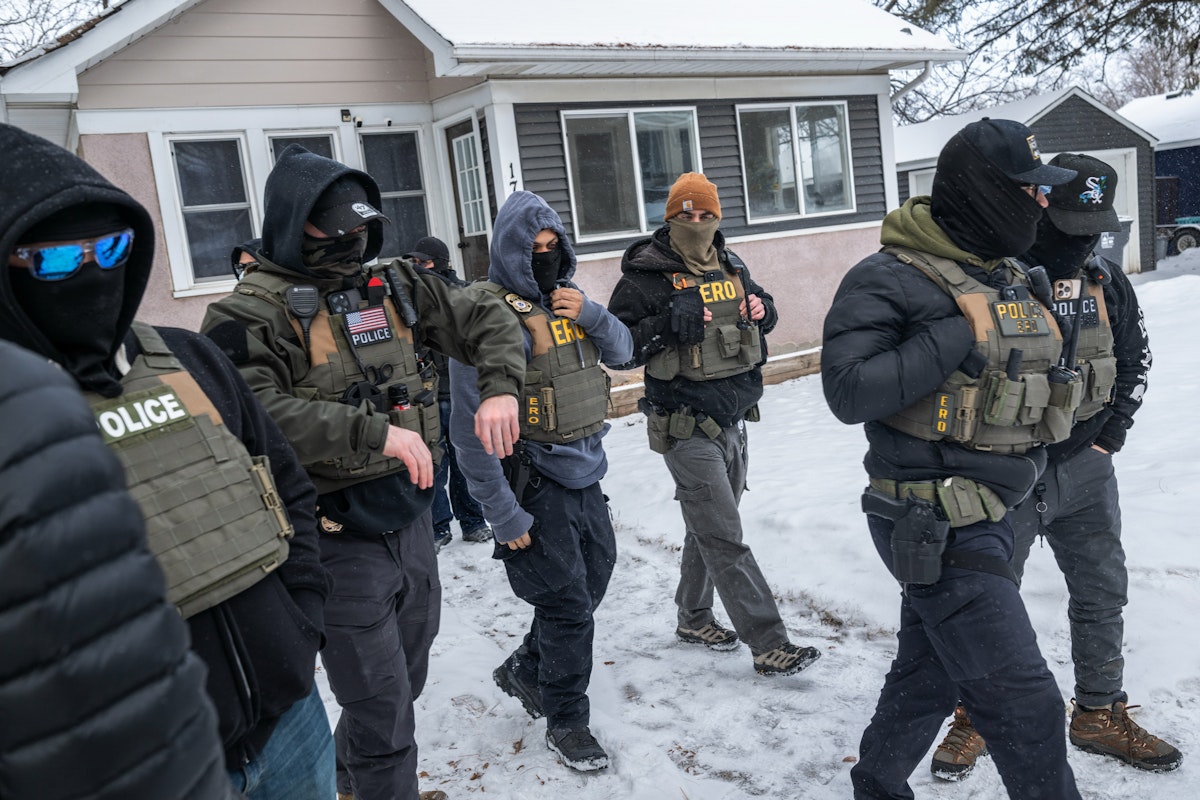
This is certainly how many Americans felt watching an Immigration and Customs Enforcement (ICE) officer shoot and kill 37-year-old Renee Good on the streets of Minneapolis. The widely viewed videos of the encounter triggered national outrage and deep concern about the Trump administration’s broader anti-immigrant policies, which have involved thousands of federal agents, including masked officers in cities across the United States with little apparent accountability.
The protests have expanded after federal agents then shot and killed 37-year old Alex Pretti, an ICU nurse at a Veterans Affair hospital, during an immigration enforcement operation in Minneapolis. His death, which was recorded on video, has intensified public outrage. Official statements about what happened, including claims by the Department of Homeland Security that he posed a threat, have been challenged by multiple video angles and eyewitness accounts showing contradictory details, such as footage of him holding a phone at the time he was shot. As a result, many Americans have been galvanized to protest, and Senate Democrats are vowing to oppose funding for ICE and related DHS funding in response to what has been taking place. “This has to stop,” President Barack Obama and Michelle Obama wrote in a statement released on social media.
This is not the first time that Americans have confronted these issues. And history shows us how quickly violence can spiral out of control when government authorities escalate, rather than defuse, fraught situations.
The killings at Kent State University on May 4, 1970, were intertwined with the controversial war in Vietnam. For more than a decade, Americans had been exposed to pervasive violence both abroad and at home. Throughout the 1960s, journalists captured unsettling images of police attacking peaceful protesters demanding integration, voting rights, jobs, fair housing, and freedom from police harassment. As the decade progressed, Americans also read about and watched the extent to which U.S. troops were killing the Vietnamese in what increasingly appeared to be a senseless and brutal war. Coverage of massacres such as My Lai revealed that individuals vested with military and policing power could not always be trusted morally.
The situation in Kent State began to unfold on Thursday, April 30, 1970, when President Richard Nixon announced on national television that the United States was invading Cambodia, a country that had previously been neutral in the conflict. Nixon explained that the operation targeted areas where North Vietnamese and their Viet Cong forces were building strength. “This is not an invasion of Cambodia,” he insisted, describing the action instead as a limited mission focused on territory controlled by the North Vietnamese. He argued that the operation was a central component of his policy of “Vietnamization,” intended to shift responsibility for the war back to South Vietnamese while reaffirming U.S. power.
The announcement followed several months in which journalists had uncovered evidence that the administration was conducting a secret bombing campaign in Cambodia. On May 9, 1969, the New York Times ran a front-page story, based on a leak, revealing that U.S. B-52 bombers had been striking targets inside Cambodian territory.
The announcement reignited the anti-war movement, which had grown somewhat quieter since Nixon’s election in 1968. Public outrage about the news in Cambodia was intense. Nixon had repeatedly assured Americans that he was bringing an end to U.S. involvement in the conflict, promising that combat operations were being transferred to the South Vietnamese forces. He also claimed to understand—better than the Democrats—why so many Americans were outraged by the mounting loss of American lives in what was widely understood as a civil war. News of the Cambodia operation made clear that these promises were not being honored.
Over the weekend, protests erupted at colleges and universities across the country, including Kent State University in Kent, Ohio, a generally quiet tree-lined campus of roughly 100 buildings, populated largely by relatively conservative commuting students. Even there, anger was palpable. Until 1970, according to the New York Times, “the school’s most serious demonstration was a 1958 panty raid on two women’s dormitories the last day of the school year.”
On Friday night, the day after Nixon’s speech, protesters blocked cars and flooded the streets. Although most of the protests were peaceful, some protesters broke shop widows and set fires. Governor James Rhodes, a former mayor of Columbus, was a moderate Republican who had served in office since 1963. As the protests unfolded, Rhodes was also campaigning for an open Senate seat. He faced Rep. Robert Taft Jr., whose father had long been the state’s—and the nation’s—most well-known conservative voice.
Seeking to bolster his own credentials, Rhodes attacked Taft as insufficiently supportive of Nixon, using the student protesters as a political weapon. A populist by instinct, Rhodes amplified his denunciations of the protesters to galvanize electoral support, labeling them radicals and communists, the “worst type of people that we harbor in America.”
By the start of the following week, troops were everywhere. “When I got back on Sunday,” one student recalled, “I thought I was in a war zone of Vietnam: helicopters that were three times anything I had ever seen, armored cars, jeeps, machine guns, mini-tanks, soldiers everywhere.” Rhodes had done little to restore calm. As historian Brian VanDeMark, author of the definitive study on Kent State, observed, “Instead of exerting a calming influence, Rhodes’s table-thumping theatrics added fuel to the fire.”
Rhodes ultimately ordered the deployment of the National Guard. On May 4, hundreds of students gathered on campus for a noon rally. As National Guard units moved toward the demonstrators, and a few threw rocks at them, tear gas was fired into the crowd, prompting students to retreat. The situation then escalated further. At 12:24, with some students gathered on a nearby parking lot, about 29 national members of the Guard opened fire, unleashing an estimated 67 rounds into the crowd.
In the years that followed, several members of the Guard acknowledged to reporters and historians that their orders had been unclear and that they had not been trained for such a confrontation. Some fired into the air, others into the crowd, and others—tragically—directly at students. One sophomore who was standing in the crowd remembered, “My brother’s roommate pulled me behind a parked car, and it was at that moment that I realized this was live ammunition because the car was riddled with bullets. The glass of the car windows was shattering above us, and we could hear that M1 bullets zipping past our heads and bumping into the ground in the pavement around us. And it was a horrifying 13 seconds.”
Four students—Allison Krause, 19; Jeffrey Glen Miller, 20; Sandra Lee Scheuer, 20; and William Knox Schroeder, 19—were killed. Two of them were simply walking to classes. Nine others were injured. Members of the National Guard later claimed that they believed their lives were in danger despite all the evidence to the contrary.
Nixon responded by releasing a statement, saying: “This should remind us all once again that when dissent turns to violence, it invites tragedy. It is my hope that this tragic and unfortunate incident will strengthen the determination of all the nation’s campuses—administrators, faculty and students alike—to stand firmly for the right which exists in this country of peaceful dissent and just as strongly against the resort to violence as a means of such expression.” In other words, the students were the problem.
The events at Kent State triggered national outrage over the war; Nixon; the conduct of Rhodes and the Ohio National Guard; and the condition of U.S. democracy more broadly. The state government had created a volatile and dangerous situation rather than deflating tensions. Nixon’s ongoing rhetoric that vilified largely peaceful activists, which Rhodes echoed, heightened the risk of violence. The historian and political scientist Howard Zinn recalled, “On television I saw the father of one of the victims, Allison Krause, barely able to control his grief, pointing to the fact that President Nixon had referred to student protesters as ‘bums.’ He cried out, ‘My daughter was not a bum!’”
Protests spread rapidly across the country, including a nationwide student strike. The strike had been underway since Nixon made his televised speech about Cambodia but vastly expanded after Kent State. Classes were suspended on almost 100 campuses. At Brown University, 1,500 students congregated at Meehan Auditorium calling on the administration to take a position on Cambodia; the faculty sent a letter to Nixon, as well as the state’s congressmen, supporting an end to the war. At the University of Wisconsin, Milwaukee, over 3,000 students rallied and blocked access to the student union. A few hundred of the protesters then occupied the library and a power plant. As a result of similar disruptions all over the country, 20 campuses would shut down for the remainder of the year.
The anger grew when, a few days later, two Black students protesting the war in Cambodia were killed by Mississippi police at Jackson State College, and 12 others were wounded.
The fury breathed new life into the antiwar movement, which would remain a major challenge for the administration until the United States finally withdrew under the Paris Peace Accords in 1973. While many factors shaped the election outcome in Ohio, Rhodes lost in the primary on May 5 by roughly only 5,000 votes.
State and federal investigations followed, though neither produced outcomes that satisfied everyone who was upset about what happened. A state grand jury concluded that the shootings were unwarranted but found no evidence of criminal wrongdoing. A federal grand jury indicted eight National Guard members, yet prosecutors ultimately failed to establish that they had acted with the intent required to sustain civil rights charges.
Some measure of redress came in 1979, when the state agreed to pay damages to several of the victims’ families as part of a $675,000 civil settlement. Under the terms of the agreement, some of the members of the National Guard signed a letter expressing regret.
The deaths were memorialized in the classic song “Ohio” by Crosby, Stills, Nash, and Young, released later that year and still a staple in many playlists. Its lyrics captured the shock and anger of the moment: “Tin soldiers and Nixon coming/ We’re finally on our own/ This summer I hear the drumming/ Four dead in Ohio.”
In 2026, many of the same fears and anxieties about the dangers that citizens face from government power have returned. In cities such as Minneapolis, residents have watched masked troops flood the streets and engage violently with citizens, legal residents, and undocumented immigrants, confronting this threat as part of daily life. Others in cities such as Chicago and Los Angeles have experienced versions of the same phenomenon, though the intensity appears to be escalating. Even those observing from afar can sense a growing menace in what is unfolding and worry about what may soon arrive in their own communities.
In 1970, Kent State inspired an awakening in many parts of the country about what the government was doing wrong and what must never happen again if our constitutional democracy is to remain whole. Today, in an era of fragmented news, disinformation, unfiltered social media, and demagogic politicians, the political impact of Good and Pretti’s death remains uncertain. Their killing by federal agents in Minneapolis has sparked massive protests, but whether it will produce sustained political pressure or be remembered as just one more episode in a turbulent year is still unclear.
Kent State demonstrates both the persistence of these dangers and the capacity of the nation’s democratic pulse to surge. The protests that have unfolded in the days following Good and Pretti’s death suggest that this democratic impulse remains alive. But, as the 1970s made clear, turning outrage into lasting change requires mass mobilization—one that brings together engaged citizens, elected officials, journalists, and other civic action.